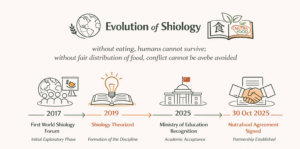
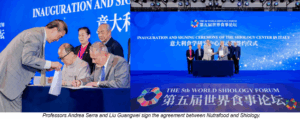
The University of Pisa, through its Nutrafood Centre, is the first University in Europe to have signed an agreement with the Shiology Centre in China. The protocol was signed on 30 October 2025 by Professor Andrea Serra (Director of the Nutrafood Centre) and Professor Liu Guangwei, Director of the Research Centre and founder of Shiology, on the 5th World Shiology Forum, held in Haikou (Hainan, China) from 28 to 31 October 2025.
The agreement provides for the possibility, subject to the conclusion of specific implementing agreements, of organizing joint courses, international seminars and workshops on topics of common interest, as well as promoting scientific and technical cooperation and developing joint research projects.
Shiology is an emerging discipline that, as of 2025, has been recognized by the Ministry of Education of the People’s Republic of China as an academic university discipline.
Shiology studies food and the act of eating as central phenomena of the human experience, placing the eater (the person who eats) at the core of the analysis. The term derives from the Chinese character Shi (食), which denotes both food and the act of eating, and reflects an integrated approach that overcomes the fragmentation typical of traditional food systems and food policies.
Shiology integrates nutrition, agriculture, environment, culture, economics, gastronomy, and education within a unified, anthropocentric framework. This approach extends the concept of “farm to fork”, encompassing not only production and distribution stages, but also the active role of the consumer and the lived experience of eating. Shiology therefore considers the full set of activities, systems, and consequences related to food, from production to consumption, and including effects on health and longevity, social dynamics, and ecosystems. In this perspective, food is not viewed merely as an economic or nutritional resource, but as a key element for human well-being, environmental sustainability, and the balance between individuals and society.
Shiology was theorized in 2019 by Liu Guangwei, founder and Director General of the World Shiology Forum, and supported by academic research centres, including Renmin University of China, as a new system of knowledge capable of responding to global food crises. Through an interdisciplinary and solution-oriented approach, shiology combines science, ethics, culture, economics, technology, and education to identify the root causes of interconnected problems such as hunger, malnutrition, food waste, and environmental degradation, while promoting more inclusive and sustainable models of governance.
Another central element is the importance attributed to food education, with initiatives aimed at increasing awareness and sensitivity to food-related issues.
Since 2017, World Shiology Forums have been held regularly, and in 2025 the permanent technical-scientific committee produced the “Global Food Systems and SDGs Report 2025 – A Systematic Stocktake of Food-Systems Issues and Solutions”, which offers a systemic and integrated reading of global food systems considering the FAO Sustainable Development Goals (SDGs). The report is based on the concept of the five eater needs—eating enough, with variety, in safety, for health and longevity, and in a sustainable way—understood as expressions of the universal right to food and shows how 13 of the 17 SDGs are directly or indirectly related to food. Through a broad base of comparable data, the document maps and codifies the main criticalities of food systems, evaluates them, and ranks countries based on analytical outputs, identifying structural gaps and proposing strategies for mitigation and overcoming these challenges.
The link between shiology and the SDGs of the United Nations 2030 Agenda is therefore central: shiology particularly supports SDG 2 (Zero Hunger), SDG 3 (Good Health and Well-being), SDG 12 (Responsible Consumption and Production), and SDG 13 (Climate Action), offering a conceptual framework to rethink food systems in terms of human well-being and long-term sustainability. Although it is an emerging discipline, its international impact and “rebound” are evidenced by the growing involvement of academic institutions and global organizations, as well as by recognition from the United Nations: Secretaries-General António Guterres and Ban Ki-moon have highlighted the value of shiology as a fundamental knowledge tool for transforming food systems and supporting the implementation of the 2030 Agenda.
In this sense, shiology presents itself as a new global interpretative framework to ensure health, equity, and resilience through food.